

WHAT IS PILATES?
Pilates is an exercise and movement method aimed at strengthening the body and keeping it supple. It improves your posture and helps prevent injuries. You’ll learn to develop and improve healthy movement patterns. You’ll build stability, strength, mobility, and flexibility. You’ll get to know your body better and leave a class feeling energized.
Pilates is a unique combination of conscious movement and creating a healthy balance between body and mind. The method focuses primarily on strengthening the deeper muscles, also known as the “core” muscles: abdomen, back, pelvic floor, and diaphragm. By training these muscles, you create more stability from the core of your body. This provides a strong foundation for all daily movements and sports activities.
A key principle of Pilates is control. The exercises are performed slowly and precisely, with a strong focus on breathing, concentration, and body alignment. Quality of movement always trumps quantity. This makes the method suitable for both beginners and advanced practitioners, young and old, athletes and non-athletes.
Pilates helps you stay flexible and strong well into old age, reducing the risk of injury. It can also alleviate ailments such as back, neck, and shoulder problems, which often arise from poor posture or prolonged sitting.
The method also helps with injury recovery. Physiotherapists worldwide use the Pilates method as a supplement to conventional treatments, because it strengthens the body in a safe and controlled manner.
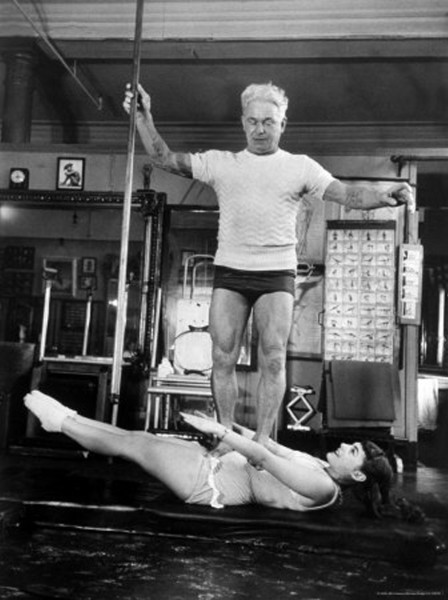
Pilates is not new. The method was developed in the early 20th century by Joseph Pilates. During World War I, he helped injured soldiers rehabilitate by developing exercises that improved strength and mobility. In the 1920s, he moved to New York, where he worked with professional dancers and athletes. After his death in 1967, his method was further disseminated and developed. Thanks to new insights from physiotherapy and movement science, Pilates continues to evolve.
WHAT IS THE DIFFERENCE BETWEEN MAT PILATES AND REFORMER PILATES
Mat Pilates
Mat Pilates is performed on a mat, using your own body weight. Sometimes small equipment such as a ball, ring, or elastic band is used to provide additional challenge or support.
Characteristics of Mat Pilates:
Focus on core stability and body control.
Working with your own body weight.
Much attention is paid to breathing and technique.
Accessible and suitable for all levels.
Good for developing body awareness.
Mat Pilates often requires a lot of control because you work without the support of equipment. This helps you learn to use your muscles efficiently and functionally.
Reformer Pilates
Reformer Pilates is performed on a special device: the Reformer. This device consists of a sliding platform with springs that provide resistance. The resistance can be adjusted, allowing you to make the exercises easier or more challenging.
Features of Reformer Pilates:
Working with adjustable resistance using springs.
Plenty of exercise variety.
Both support and additional challenge are possible.
Especially suitable for rehabilitation and intensive training.
Targeted muscle strengthening and mobility.
The Reformer can provide support during certain exercises, making it suitable for people with injuries. At the same time, the device can make the workout more intense for those seeking more challenge.
WHICH FORM IS RIGHT FOR YOU?
Both forms share the same basic principles and work on strength, stability, flexibility, and control.
Mat Pilates is accessible and pure, while Reformer Pilates offers more variety and resistance. Many people combine both forms for optimal results.
Regardless of your choice, Pilates helps you move stronger, more smoothly, and more consciously—resulting in a healthy and energetic body.
Learn more about our studio here and view the schedule to book a class.
In the 1951 photo, Joseph Pilates stands atop opera singer Roberta Peters. Photo: Michael Rougier for Life Magazine.